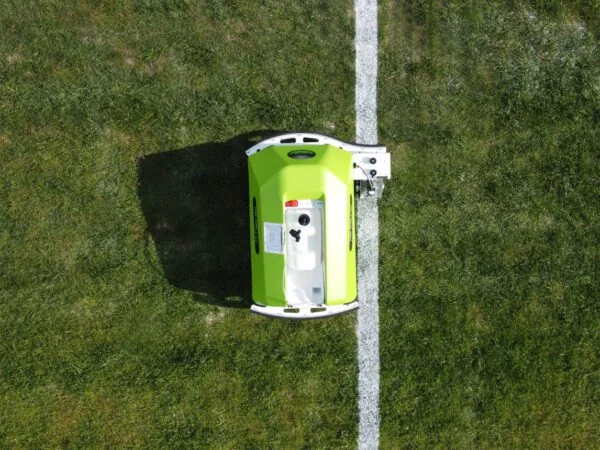
Outdoor
- Key feature
- 24 min per soccer field
- Runtime
- 5 h
- Key feature
- 20 L paint tank
On order
Price on request
Updated
USE CASE · GREEN SPACES
The robot paints pitch lines from templates, guided by satellite, while the groundsperson prepares the next pitch. Teams keep mowing, watering, turf care and the final check.
Updated
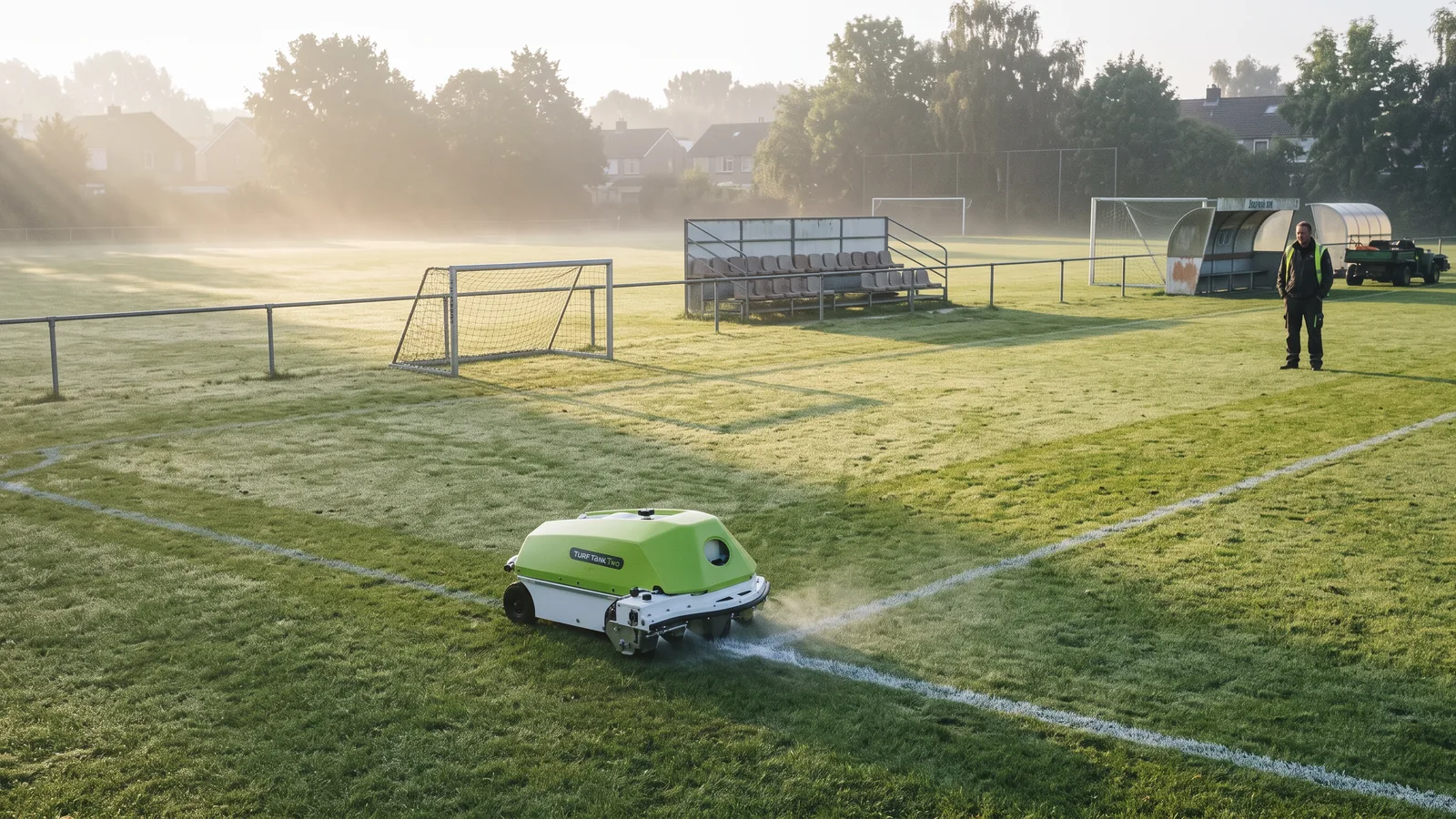
A line marking robot autonomously paints the lines of football, rugby and other sports pitches from templates, positioning itself by GNSS, with no string lines or ground measurements.
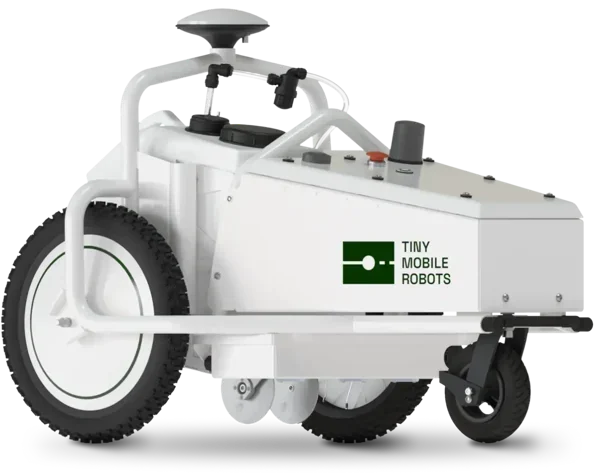
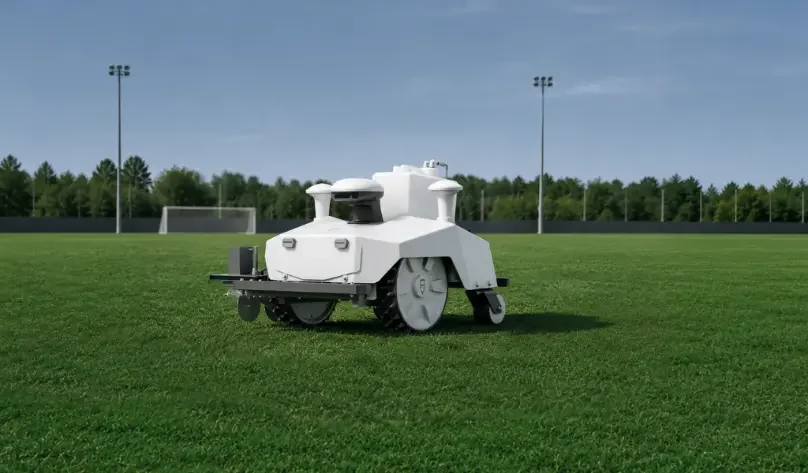
The Turf Tank Two marks an 11-a-side football pitch in about 24 min, paints at 1 m/s and runs more than 5 h per charge, according to its manufacturer.
Robot Distribution delivers it, sets up your pitches in the app, trains your staff and maintains it, to buy, rent or as RaaS.
WHY
At a municipal sports ground, a stadium or school playing fields, lines fade with mowing, rain and play and must be repainted every week in season. Manual marking often takes two people, string lines and measuring before every match.
The robot finds each saved pitch and repaints its lines on its own, in the same place every time. One person is enough to bring it out, fill the paint and watch the job.
HOW IT RUNS
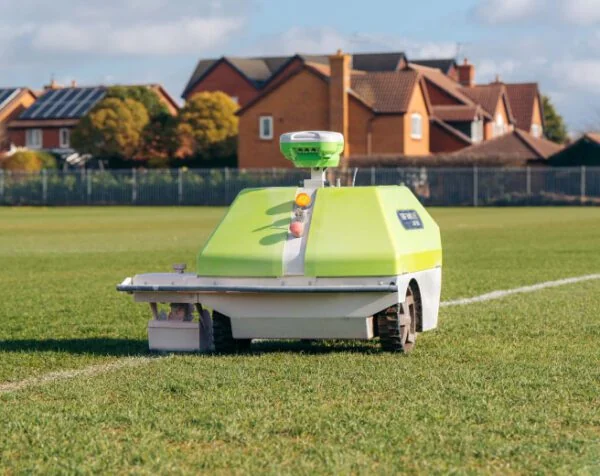
We choose the template (football, rugby, small-sided pitches) and position the pitch on the tablet. The FJD PaintMaster Pro offers more than 250 templates and the TinyLineMarker Pro X more than 200, according to their manufacturers.
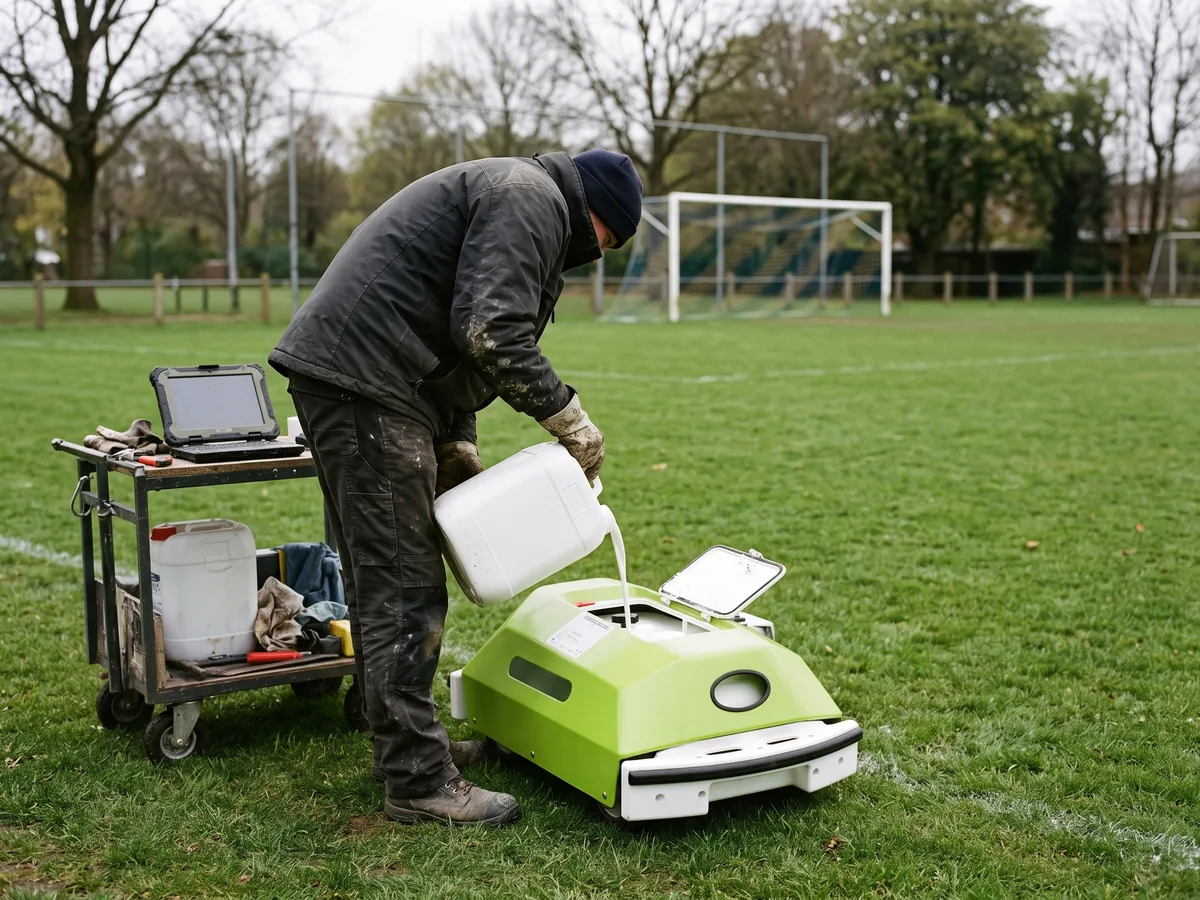
The groundsperson fills the paint tank, checks the nozzles and, depending on the model, sets up the GNSS base: the TinyLineMarker Pro X works without a base, the Turf Tank Two with a local base station, according to their manufacturers.
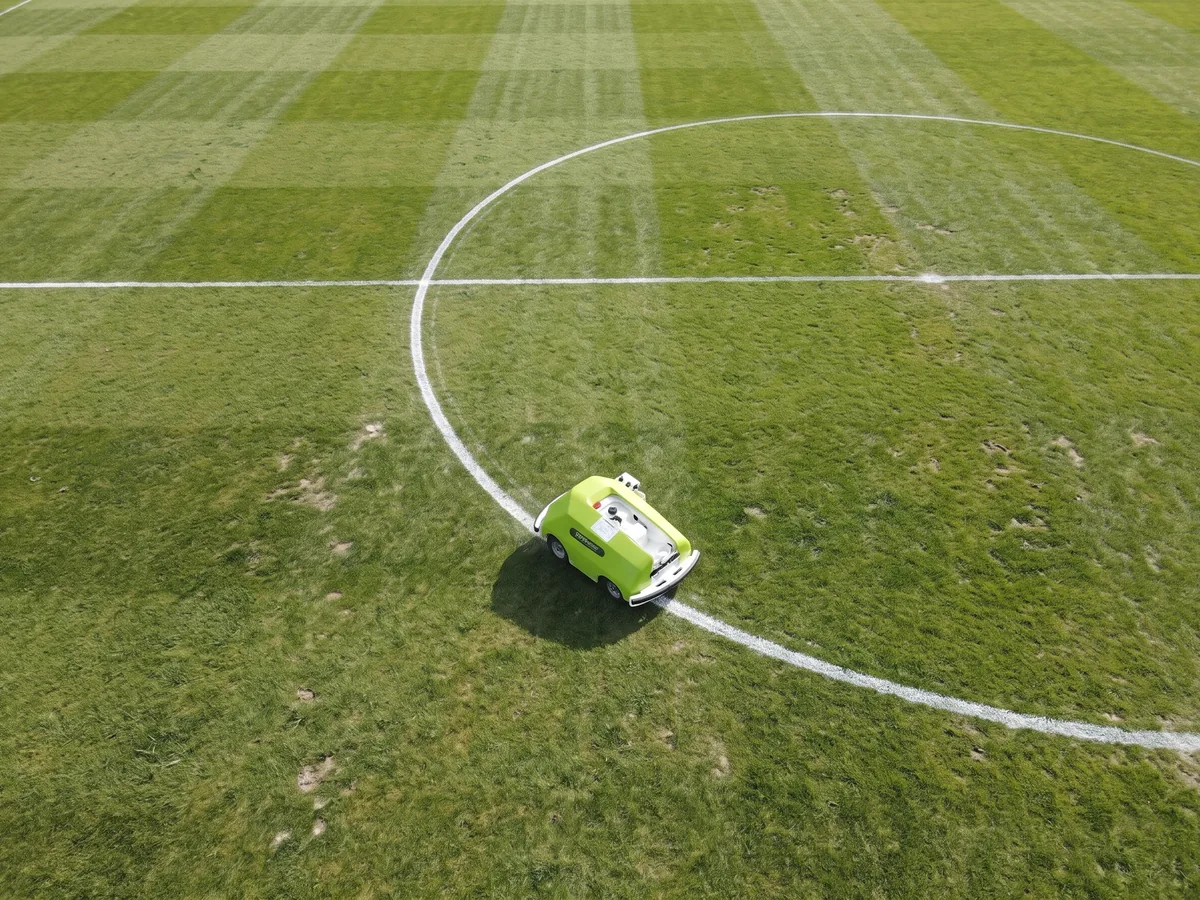
The robot paints the pitch lines, lifting the nozzle between segments. The TinyLineMarker Pro X states 1 to 2 cm accuracy and about 25 min for an 11-a-side football pitch, according to its manufacturer.
The saved pitch is re-marked every week in the same place. The groundsperson rinses the nozzles and paint circuit and recharges the battery: about 4 h for the 1 kWh battery of the FJD PaintMaster Pro, according to its manufacturer.
THE ROBOTS
Outdoor
Outdoor
BEFORE INSTALLING
The number of pitches, the sports played and how often they are marked guide the model: the Turf Tank Two marks at least ten 11-a-side football pitches per charge, according to its manufacturer.
Stands, trees and nearby buildings can disturb GNSS: reception is checked on each pitch, along with the network needed for the FJD PaintMaster Pro's NTRIP correction.
Paint type, natural or artificial turf and the required line width are confirmed: the FJD PaintMaster Pro marks lines 6 to 17 cm wide, according to its manufacturer.
We check the route from the store to the pitch, access for a robot of about 35 to 73 kg depending on the model, and the water point for rinsing.
RULES AND STANDARDS
The robot's templates must match the Laws of the Game and the French football federation's ground rules, and the machine itself falls under EU machinery law.
Law 1 of the IFAB sets that all lines have the same width, no more than 12 cm, that goal lines match the width of the posts and crossbar, and that lines belong to the areas they bound. Only Law 1 lines may be marked; on artificial surfaces, other lines are allowed if clearly distinguishable. Check that each saved template follows these points.
The 2021 French federation rules (RTIS), adopted on 11 December 2021, set line width at 10 to 12 cm, 5 to 7 cm on small-sided pitches, with a length tolerance of 0.1% for levels T1 to T3 and 0.5% for T4 to T7. Eleven-a-side lines are white. Check the robot's template library and accuracy against the pitch's classification level.
Article 3.8 of the RTIS bans any herbicide for marking or pre-marking. Marking of a different nature from the surface needs a prior regulatory opinion. On synthetic turf, lines are preferably permanent, and the number of permanent multisport layouts depends on the level, up to three for T5 to T7. Agree the paint and the layouts with the club before programming.
From 20 January 2027, Regulation (EU) 2023/1230 applies to autonomous mobile machinery such as line marking robots. According to INRS, travel must take place in an enclosed space or with person and obstacle detection, and the supervision function only allows a remote start, stop or move to a safe state. On school or public grounds, ask how the robot detects people crossing the pitch.
General information, not legal advice.
FAQ
According to the manufacturer: about 24 min for an 11-a-side pitch with the Turf Tank Two and about 25 min with the TinyLineMarker Pro X. The Turf Tank One, the brand's original model, paints at 0.6 m/s.
It depends on the model. The Turf Tank robots use RTK with a local base station; the FJD PaintMaster Pro a base station or NTRIP correction; the TinyLineMarker Pro X works without a base using GPS, Galileo, GLONASS and BeiDou, according to their manufacturers.
According to the manufacturer: 25 L for the FJD PaintMaster Pro, 20 L for the Turf Tank Two and One, 18.9 L for the TinyLineMarker Pro X. The Turf Tank One marks a full football pitch without refilling its tank.
According to the manufacturer: up to 10 h for the FJD PaintMaster Pro with its swappable 1 kWh battery, more than 5 h for the Turf Tank Two, 5 h for the TinyLineMarker Pro X and about 4 h for the Turf Tank One.
Yes for the FJD PaintMaster Pro, which offers logo marking in addition to its pitch templates, according to its manufacturer.
USE CASES
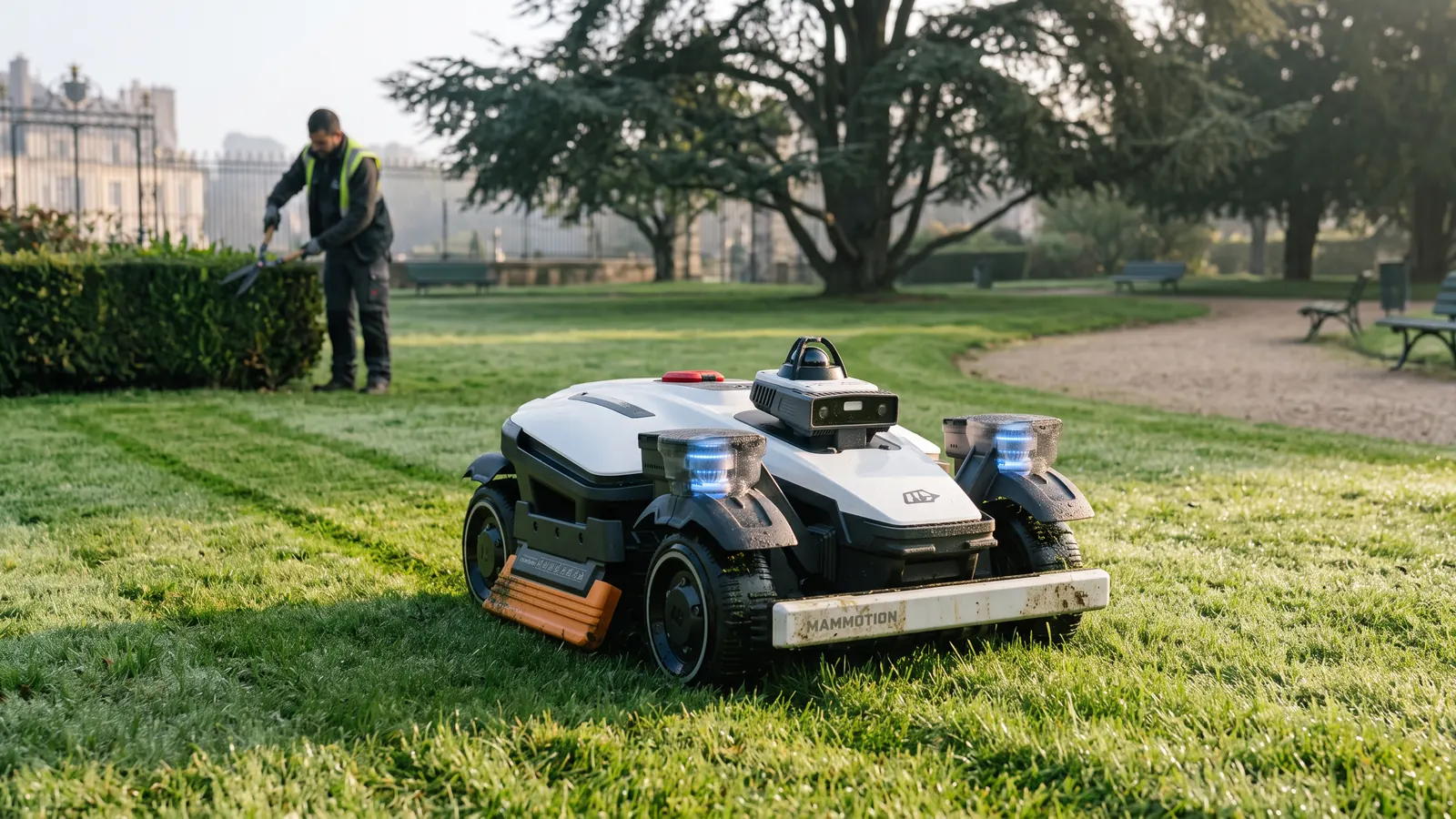 Robotic mowing of parks and groundsThe robot mows regularly, by zones set in the app, with no wire to bury. Gardeners keep pruning, beds, edges and seasonal work.
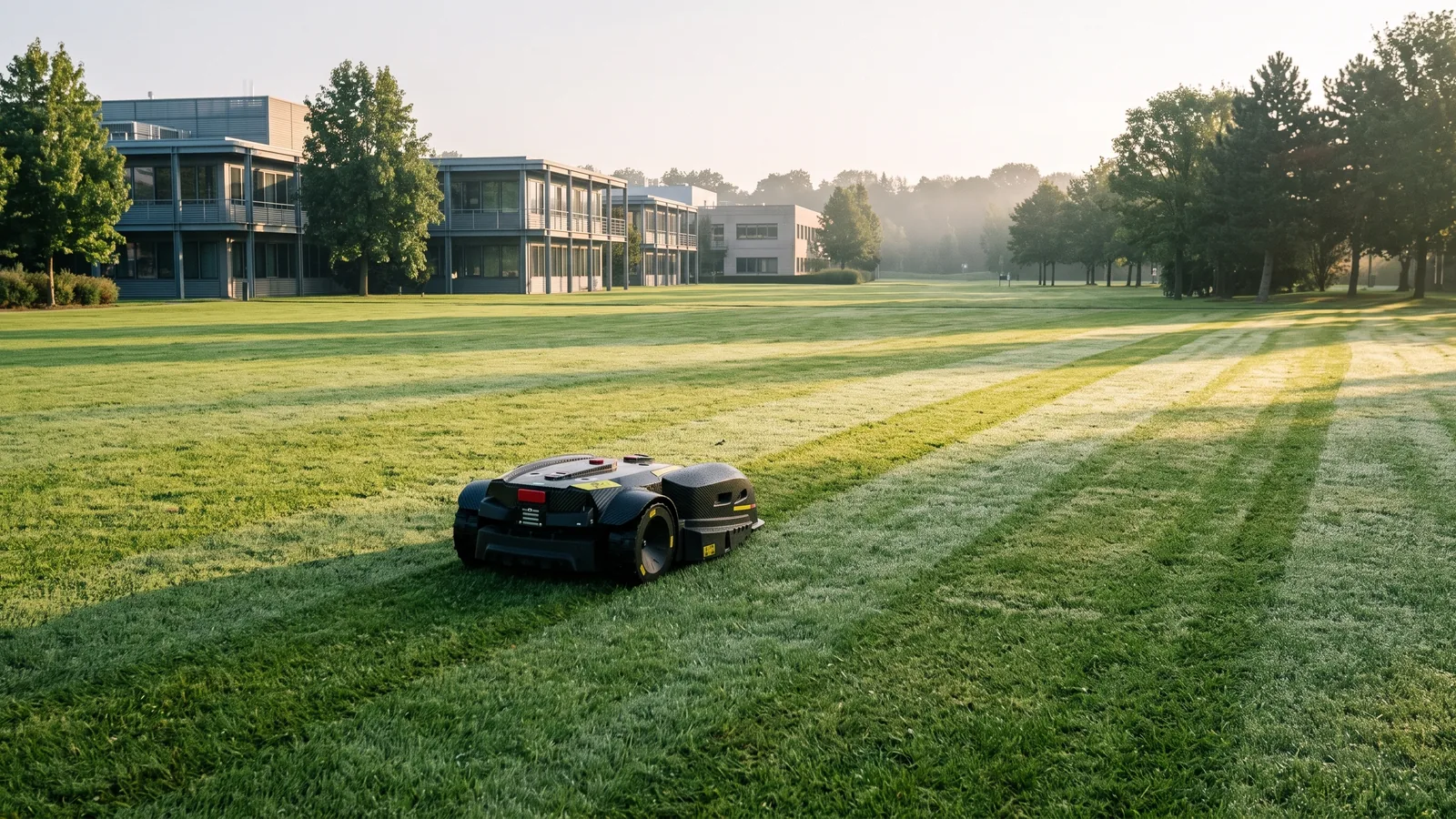 Large-area professional robotic mowingOn large grounds, commercial robotic mowers cut every day in satellite-guided stripes. Teams keep the finishing, overseeding, irrigation and care of the surroundings.
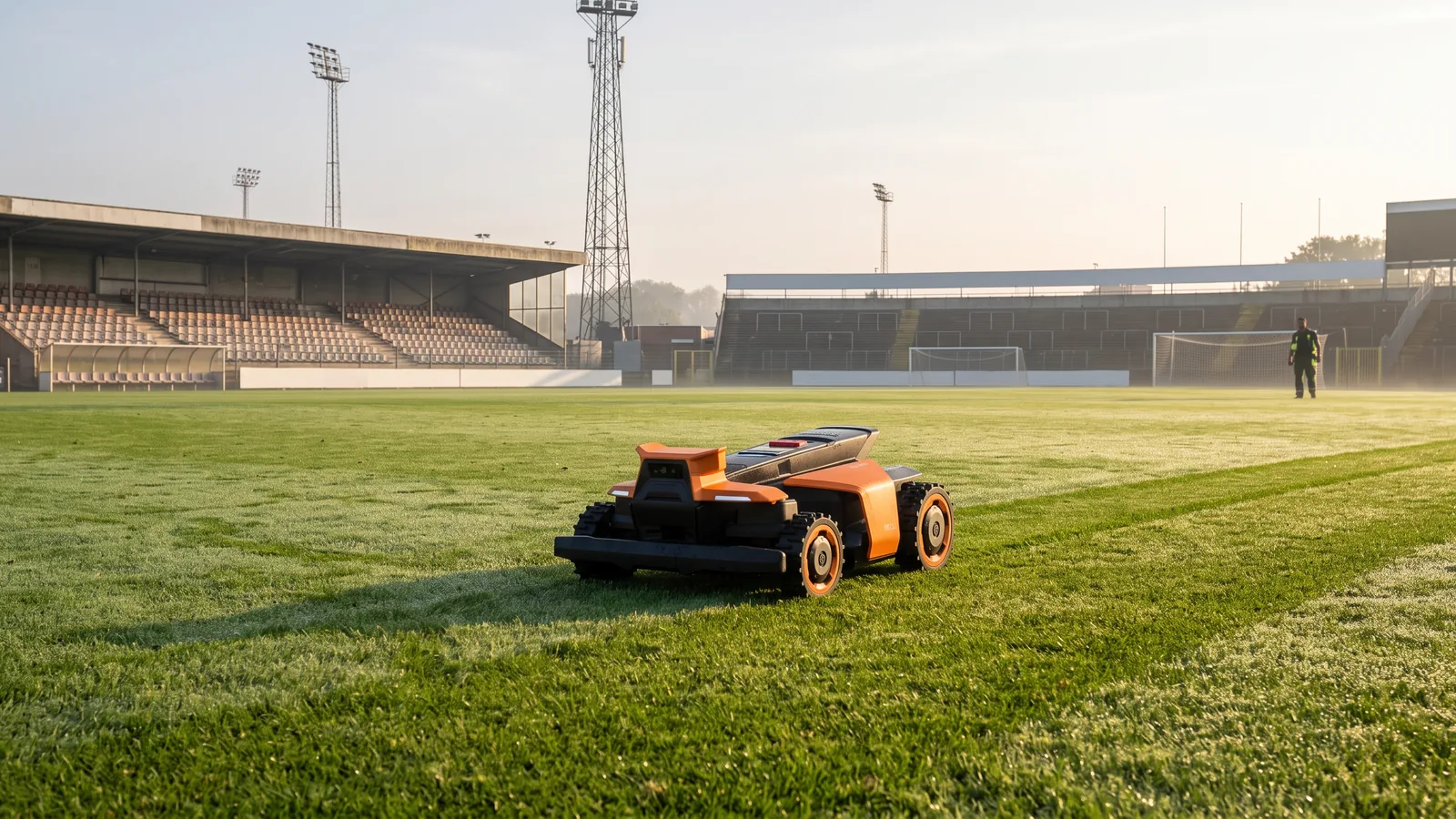 Robotic maintenance of natural-turf sports pitchesA robot mower cuts the pitch several times a week at a constant height, and a line-marking robot repaints the lines before each match. The groundsman runs the programme and keeps the agronomic work.
Robots, acquisition mode and delivery terms, in one written proposal.