MARKET
Solar panel cleaning robots: why European solar farm operators are looking at them
By Robot Distribution editorial teamPublished 5 min read
IN BRIEF
Soiling, the dust, pollen and dirt that settle on PV modules, is estimated by IEA PVPS to cost 3 to 5% of annual PV energy production. The EU fleet reached 406 GW at the end of 2025, according to SolarPower Europe. Cleaning robots, fixed on the rows or moved from table to table, clean modules without manual brushing.
Soiling: what it is and what it costs
Soiling is the accumulation of dust, sand, pollen, bird droppings and other deposits on the surface of PV modules. It blocks part of the light that reaches the cells and lowers the energy the plant produces.
- The IEA PVPS Task 13 report on soiling, published in January 2023, estimates that soiling causes a loss of 3 to 5% of annual PV energy production and an economic loss of 3 to 5 billion euros.
- The same report describes soiling as the most influential factor on PV yield after irradiance.
- A 2019 study in the journal Joule, led by Fraunhofer CSP with DLR and other institutes, found that soiling reduced global solar power production by at least 3 to 4% even with optimised cleaning.
Losses vary widely by site: dust, agriculture, roads, rainfall and module tilt all change how fast modules get dirty. A soiling measurement on site is the basis for choosing a cleaning frequency.
Installed PV capacity in the EU and in France
| Area | Capacity | Added in 2025 | Source |
|---|---|---|---|
| European Union | 406 GW (DC) | 65.1 GW | SolarPower Europe, 11 December 2025 |
| France | 30.4 GW (30,438 MW) | 5.9 GW (5,941 MW) | Panorama de l'électricité renouvelable, SER, RTE, Enedis, Agence ORE |
According to SolarPower Europe, the EU installed 65.1 GW of solar in 2025, slightly less than the 65.6 GW of 2024, and France overtook Italy as the third-largest EU solar market. According to the Panorama de l'électricité renouvelable, solar produced 32.9 TWh in 2025 and covered 7.4% of annual electricity consumption in mainland France.
The main types of cleaning robots
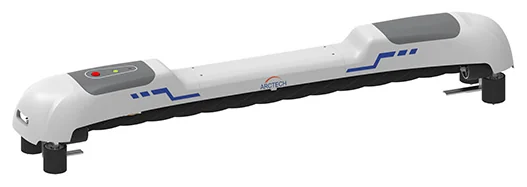
- Row robots: a robot stays on a row of modules, travels along it on a schedule, usually at night, and returns to a docking station to charge. They suit large ground-mounted plants and single-axis trackers, and most clean dry.
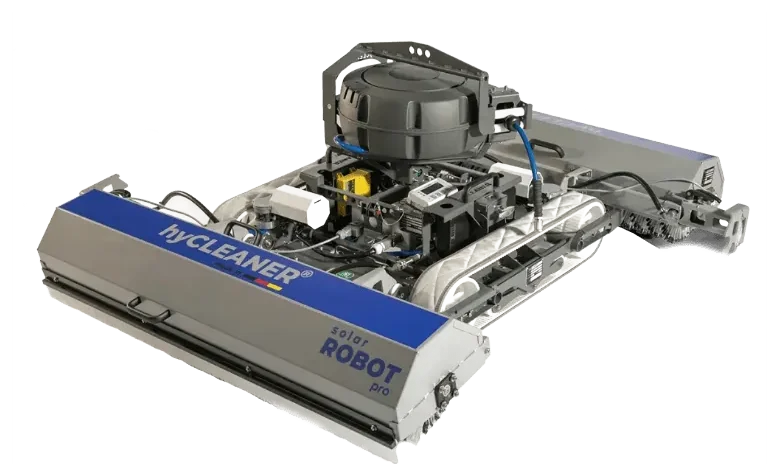
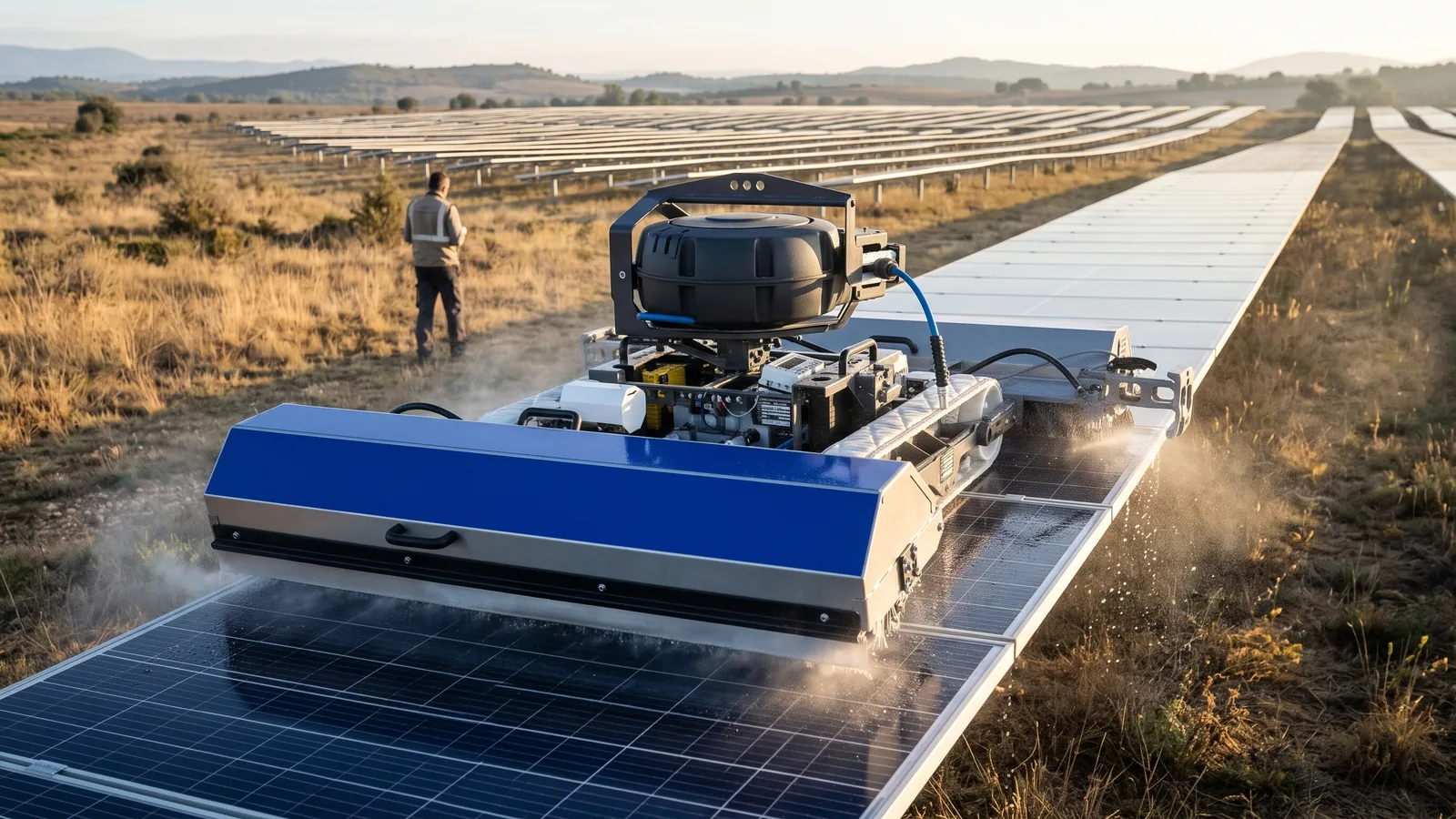
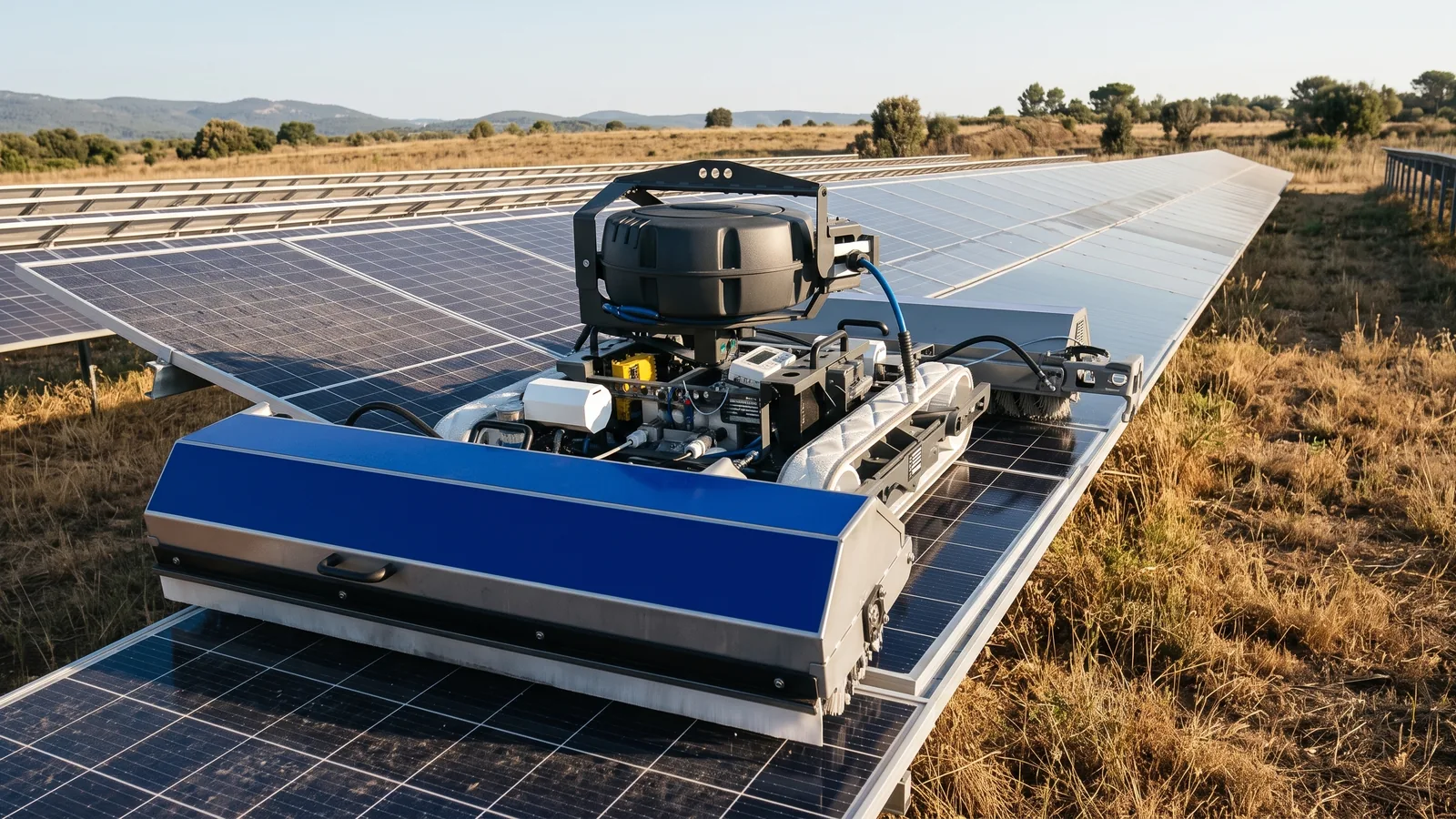
- Crawler robots: a tracked robot is placed on the modules and driven by radio remote control, then moved from table to table. They suit rooftops, carports and plants without a robot on every row, and can clean dry or with water.
- Dry or wet: dry robots brush or wipe dust off with microfibre and need no water on site. Wet cleaning uses a water supply, often a hose, and removes stuck deposits such as bird droppings.
In both cases the operator keeps the electrical checks, the monitoring and the maintenance of the plant. The robot only does the cleaning.
Four robots from our catalogue
| Robot | Type | Main figures |
|---|---|---|
| Arctech Star Shine I | Row robot, dry | About 40 kg, 10 to 20 m/min, up to 5 km per trip, module tilts of 10 to 30°, charges at its docking platform |
| Ecoppia T4 | Row robot for single-axis trackers, dry | Microfibre and controlled airflow, cleans in stow position, solar-powered, autonomous and cloud-managed, frameless modules supported |
| hyCLEANER solarROBOT pro | Crawler, remote-controlled | Cleaning width up to 2,400 mm, up to 3 h on a 36 V battery, slopes up to 25° depending on surface, about 89 kg |
| SolarCleano F1 | Crawler, remote-controlled, dry or wet | Up to 1,600 m²/h, about 80 kg, about 2.5 h runtime, crosses gaps between tables up to 700 mm, garden-hose water supply |
The solar panel cleaning robot page compares the models by type of installation, slope and access.
What to check before choosing
- Type of structure: fixed tilt, single-axis tracker, rooftop or carport.
- Row length, tilt, gaps between tables and obstacles on the rows.
- Water availability and quality on site, if wet cleaning is needed.
- Soiling rate measured on site and the cleaning frequency it calls for.
- Who operates the robot: a fixed fleet that runs alone, or a crawler moved by a technician.
- Module manufacturer's cleaning instructions, so that the method does not affect the module warranty.
Robot Distribution supplies these robots for purchase, rental or RaaS, with installation and after-sales service. Send your plant data through the quote form.
Sources
- Soiling Losses – Impact on the Performance of Photovoltaic Power Plants (Report IEA-PVPS T13-21:2022) · IEA Photovoltaic Power Systems Programme (IEA PVPS) · accessed
- Ilse et al., Techno-Economic Assessment of Soiling Losses and Mitigation Strategies for Solar Power Generation, Joule 3(10), 2019 · DLR elib (Fraunhofer CSP, DLR et al.) · accessed
- New report: EU hits 2025 solar target but market contraction puts 2030 goal at risk · SolarPower Europe · accessed
- Panorama de l'électricité renouvelable au 31 décembre 2025 · SER, RTE, Enedis, Agence ORE · accessed